Bhadra Store
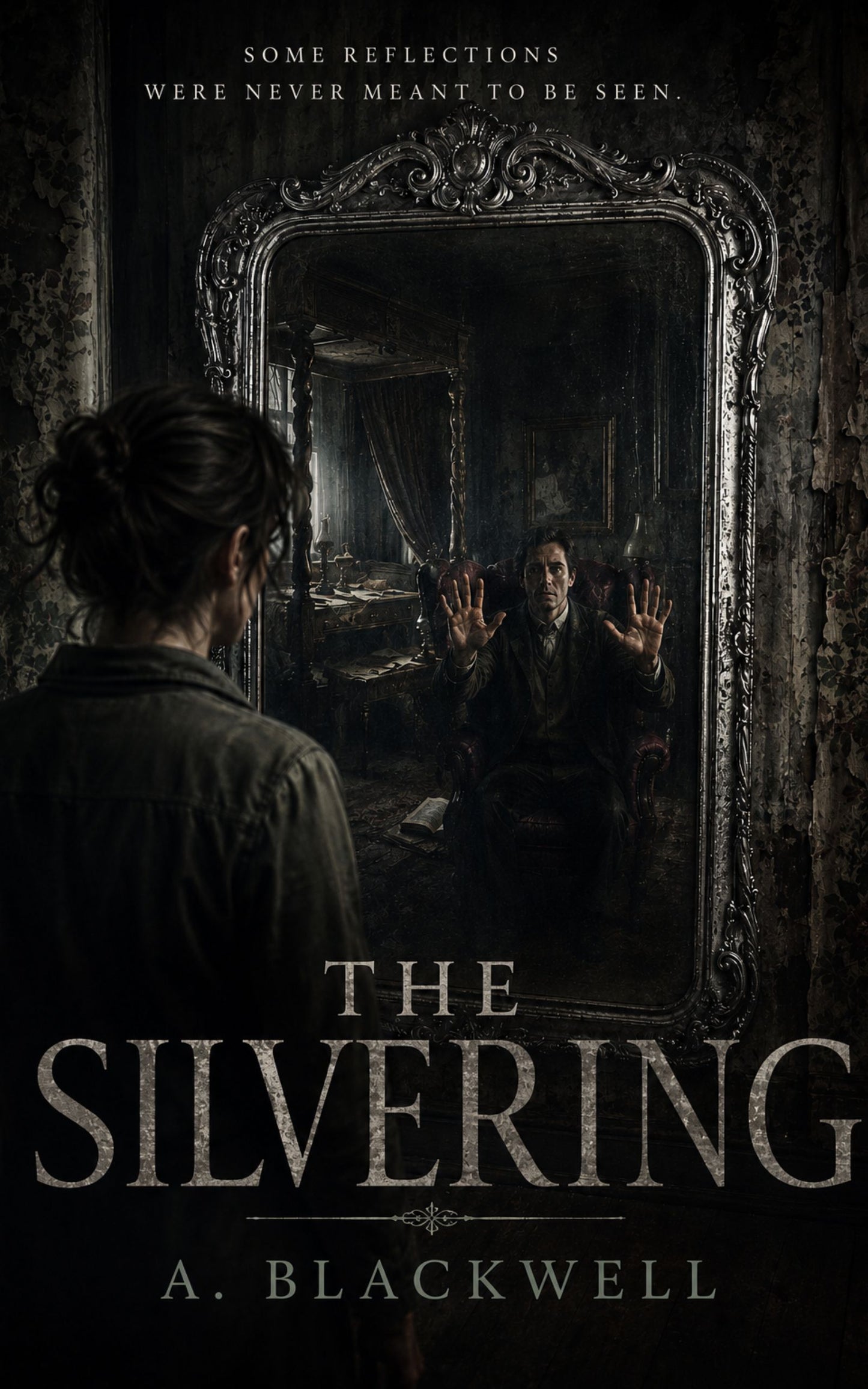
The Silvering
The Silvering
Couldn't load pickup availability
The Silvering
Genre: Gothic Horror | Date: 2026-05-15
The mirror wasn't on any inventory. Elara found it on her fourth day at Blackwood Hall, behind a wall of rotting floral wallpaper in the east wing's smallest bedroom, and from the moment her utility knife caught the edge of the tarnished silver frame, she understood why someone had tried to hide it.
She was thirty-four, a restoration specialist hired by the estate's liquidators to catalog and appraise before the auctioneers descended like vultures. Blackwood Hall had belonged to Alistair Vane, a collector of improbable wealth and impeccable obscurity, who had died three months earlier at ninety-one without heirs or friends. The house breathed neglect. Dust hung in the air like suspended judgment. Every surface wore a gray skin of abandonment.
The hidden room was perhaps twelve feet square. No windows. The air inside was still and cold in a way that had nothing to do with the broken radiator in the hall — a deeper cold, the kind that settled in bone rather than skin. And dominating the far wall, nearly eight feet tall in its ornate silver frame, stood the mirror.
Its glass was immaculate. No tarnish, no foxing, no silver rot. After decades sealed behind a wall, it reflected the beam of Elara's flashlight with the clarity of polished water. She stepped closer, professional curiosity overriding the prickle at the base of her skull.
The reflection showed the room behind her. But the room behind her was empty, stripped to floorboards, lit by her flashlight alone. The room in the mirror had furniture. A four-poster bed with heavy drapes. A writing desk cluttered with papers. A wingback chair upholstered in wine-colored velvet. And in the chair, a man.
Elara spun around. Nothing. Just floorboards and wallpapered walls and the distant drip of a leak somewhere in the attic. She turned back to the mirror. The man was still there, seated in profile, frozen as if in a photograph. He wore a high-collared shirt and a smoking jacket, his hair dark and slicked back. Early thirties, perhaps. Handsome in a severe, hawkish way. A book lay open in his lap, but his eyes were not on the page. They were directed at something beyond the frame.
She told herself it was a trick of the glass. An antique photograph mounted behind the silvering, some Victorian novelty she'd never encountered. She covered the mirror with a drop cloth and returned to her inventory.
The next morning, the drop cloth lay in a heap on the floor.
Elara stared at it, then at the mirror. The man had moved. He was no longer in profile. His face was turned toward her — or nearly toward her. Three-quarters. His mouth was slightly open, as if he'd been interrupted mid-word. The book had slipped from his lap to the floor of the mirror-room, its pages fanned open.
She didn't cover the mirror again. She couldn't explain why. Something in her resisted the impulse, the way a tongue resists probing a sore tooth even as the compulsion builds.
That afternoon, she found Alistair Vane's journals in the library. The old man's handwriting deteriorated across the decades, but the early volumes were precise and elegant. She searched for any mention of the east wing, the hidden room, the mirror. She found it in the journal from 1952, when Vane would have been seventeen.
*Father has sealed the east bedroom. He says it's a structural concern, but I heard him tell Mother that Uncle Edmund's disappearance was connected to the glass. Connected how, he wouldn't say. Mother wept. I have never seen her weep before.*
Elara's fingers went cold on the pages. She turned to an earlier volume, 1924.
*Edmund has been missing for six weeks. The police have given up. Father spends his evenings in the east bedroom, sitting before that ostentatious mirror of his. He won't speak of it, but I've heard him, late at night, talking to someone who isn't there. Pleading. Apologizing.*
She set the journal down and realized her hands were trembling. She returned to the east wing. The light was failing outside, the autumn dusk bleeding through the hallway's single grimy window. The hidden room waited at the end of the corridor, its doorway a dark mouth.
The man in the mirror was now facing her directly.
His eyes were wide, bright with a desperation that transcended the decades. His hands were pressed flat against the inside of the glass. She could see the whorls of his fingertips, the half-moons of his nails. He was mouthing something. No sound, just the frantic shape of lips forming words she couldn't read.
Elara stepped closer, close enough to see her own reflection ghosting over his face like a double exposure. And she realized with a lurch of vertigo that the room in the mirror was no longer the room from 1924. The furniture was gone. The wallpaper had been stripped. The mirror-room was catching up.
She stumbled backward. The man's mouth kept moving, and this time she understood. Two words, repeated with the mechanical desperation of a signal that had been broadcasting for eighty years.
*Don't look.*
She looked.
Her reflection was wrong. It stood half a second behind her, a fractional delay that her mind rejected before her eyes could confirm it. She raised her hand. The reflection raised its hand a heartbeat late. She stepped left. The reflection followed, but there was a weight to its movement, a deliberation, as if it were learning the choreography of being her.
Then it smiled.
Elara had not smiled.
She fled the room and slammed the door. The sound echoed through the empty house like a gunshot. She pressed her back against the wall in the corridor, breathing in ragged gulps, her pulse a timpani in her ears. She told herself she would leave. Pack her equipment, get in the car, drive until Blackwood Hall was a dark smudge in the rearview mirror. She told herself the thing in the mirror couldn't follow. She told herself mirrors were just glass and silver nitrate and physics.
But physics had stopped applying to Blackwood Hall sometime around 1924, and she knew it.
She went back inside the room.
The man — Edmund, it had to be Edmund — was pounding on the glass now, his fists striking silently, his face contorted with a terror that had been fresh for eight decades. Behind him, the mirror-room was nearly identical to the real room. Nearly. The same stripped floorboards. The same water stain on the ceiling. But where Elara's flashlight beam cut across the dust, the mirror-room held a different kind of light entirely. A silvery luminescence that seemed to come from the glass itself.
Her reflection had stopped mimicking her. It stood still in the center of the mirror-room, watching her with her own face, wearing an expression she had never worn in her life. Hunger. Patience. Recognition.
It pressed its palm against the glass from the other side.
Elara understood then, with the clarity of a bell struck in absolute silence. The mirror didn't trap people. It traded them. Edmund had been pulled through, and something else — something that had been waiting in the silvered dark — had taken his place in the world. It had worn him. Lived his life. Aged and died as Alistair Vane's father, while the real Edmund screamed silently behind glass no one could see through anymore.
And now it was her turn.
Elara looked at Edmund's frozen, frantic face, and then at the thing wearing hers. She thought about running. She thought about the car keys in her pocket, the highway, the city waiting three hours south. She thought about all the mirrors between here and there. Rearview mirrors. Bathroom mirrors. Shop windows. Every reflective surface a door that was already opening.
The thing in the mirror tilted its head, and its smile widened, and Elara felt something cold take her by the wrist — not from the mirror, but from inside her own reflection, which had begun, very slowly, to step forward.
She didn't scream. There was no one to hear it, and besides, the sound would only echo.
Share